I.

PROGRAMME ACTIVITIES IMPLEMENTED

Seven programme activities have been successfully implemented in 2008, namely:

1.   Programme:

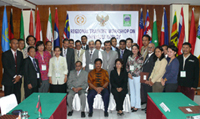
Regional Training Workshop on Renewable Energy


Venue:

Bali, Indonesia


Date:

25 February – 1 March 2008


Objective:

The objective of the training workshop is to provide participants with policy issues and basic knowledge on appropriate engineering aspects and social preparation as well as development plan of renewable energy, such as Jatropha Curcas, Wind and Waste Refinery being comercialized to generate  power developed in Bali.


Subjects Discussed:

1).   Introduction on Renewable Energy: (a) Government Policy; and (b) Public Private Partnership Scheme

2).   Institutional Aspects and Renewable Energy: Fostering Relationships

3).   Development of Jatropha Curcas as an Alternative Energy

4).   Development of Wind Energy

5).   Renewable Energy: Empowering the Third World

6).   Introduction on Integrated Waste Management System


Outcome:

A Recommendation covering basic issues as follows:

1).  The need to clearly formulate laws/policies/regulations that must be applicable and friendly interms of its mission/objectives, programme performance indicators, and putting in penalty clause for environmental damages.

2).  The need to institutionalize renewable energy promotion mechanisms at all levels from the community level to the national, regional and global levels focusing on specific renewable technologies and with full participation and support of various stakeholders (Government, NGOs, private sector, CBOs, donor agencies, unversities/academies, Research and Development Institutions).

3).   Food security must be a priority in terms of land utilization. Energy security can be derived by maximizing other renewable energy resources such as solar, wind, hydro, biomass, etc.

4).   Involve the people in the community by providing or linking them with resource institutions for the necessary capability development interventions such as social preparation, trainings (organization and technical renewable energy) and other assistance.

5).   Provide a conducive environment for various investors (foreign/local) to fund development of renewable energy by putting in place incentives such as non-collateral and low interest loans, tax reduction/ holidays, etc.


Participating Countries:

Afghanistan, India, Indonesia, Iran, Lao PDR, Malaysia, Myanmar, Nepal, Philippines, Sri Lanka, Thailand.


Number of Participants:

33 persons


Implementing Partners:

Centre on Integrated Rural Development for Asia and the Pacific (CIRDAP)


Selected Photos:


Click to View all Selected Photos !


2.   Programme:

Training on Operational Management of Microfinance


Venue:

Makassar, Indonesia


Date:

13 – 18 April 2008


Objectives:

The objectives of the training are to provide the participants with an opportunity to improve their knowledge and skills/techniques in the field of microfinance, in particular on the operational aspects of microfinance. The training also provides excellent opportunities for participants to exchange ideas, information and experiences among themselves concerning policy and technical aspects of microfinance development in their respective countries.


Subjects Discussed:

1).   Microfinance Development: Role, Regulation and Types

2).   Introduction on Sharia Microfinance Institution

3).   Lending and Funding Products

4).   Pricing/Interest Rate Setting

5).   Microfinance Institution Rating and Risk Management

6).   Loan Analysis

7).   Internal Control

8).   Standard Operating Procedure


Outcome:

Action Plans of Post-Training prepared by all participants


Participating Countries:

Cambodia, Lao PDR, Vietnam, Papua New Guinea, Timor Leste, Indonesia


Number of Participants:

16 persons


Implementing Partner:

Department of Foreign Affairs of Indonesia


Selected Photos:


Click to View all Selected Photos !


3.   Programme:

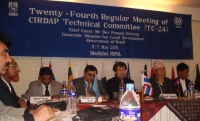
Participation of NAM CSSTC in the Twenty-Fourth Regular Meeting of CIRDAP Technical Committee


Venue:

Dhulikhel, Nepal


Date:

5 – 7 May 2008


Objective:

The objective of the twenty-fourth meeting of CIRDAP Technical Committee is to facilitate interaction among CIRDAP member countries (CMCs), CIRDAP-IRD expert (Japan), members from Professional Institutions like ICIMOD, NABARD, NAM CSSTC, Commonwealth Secretariat and members of the CIRDAP Evaluation Committee from Malaysia, India and Iran. The interaction is aimed at discussing current issues on integrated rural development of the developing countries and the role of CIRDAP in the changing global context.


Subjects Discussed:

1).   Synthesis of CIRDAP’s role and experiences in implementing its programme activities in the Asia-Pacific Region

2).   The need to extend CIRDAP’s involvement to generate benefits for pacific island nations

3).   In noting the importance of training, the focus on capacity building of CIRDAP link institutions (CLIs) becoming more relevant

4).   CLIs are mostly training and research institution providing bedrock for CIRDAP activities in CMCs, how CIRDAP could strengthen CLIs by providing technical assistance for augmenting the research and training capacities

5).   Special session on the role of CIRDAP in the changing global context


Outcomes:

1).   Decision to adopt the theme “working together for sustainable rural livelihood” for the Ministerial Meeting be held in 2009

2).   Preparation to extend the Regional Cooperation Fund

3).   Commonwealth Secretariat agreed in principle to partner with CIRDAP in advancing capacity development and networking of CLIs and host a retreat for the Heads and Deputies of CLIs

4).   Next CIRDAP Technical Meeting (2009) will be held in Iran


Participating CIRDAP Member Countries:

Afghanistan, Bangladesh, India, Indonesia, Iran, Lao PDR, Myanmar, Nepal, Pakistan, Philippines, Sri Lanka, Thailand, Vietnam


Participating CIRDAP Link Institutions and Professional Institutions:

NABARD (India), NAM CSSTC (Indonesia), ICIMOD (Nepal), LDTA (Nepal), IRD Expert (Japan), Commonwealth Secretariat (United Kingdom), IRD Expert (Japan), CIRDAP Evaluation Committee (India, Iran, Malaysia)


Number of Participants:

41 persons


Host:

Centre on Integrated Rural Development for Asia and the Pacific (CIRDAP)


Selected Photos:


Click to View all Selected Photos !


4.   Programme:

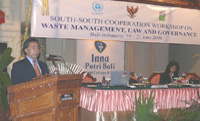
South-South Cooperation Workshop on Waste Management, Law and Governance


Venue:

Bali, Indonesia


Date:

19 – 21 June 2008


Objective:

The objective of the South-South Cooperation Workshop on Waste Management, Law and Governance is to share the best practices and lessons learned on waste management, law and governance in developing countries and ways as well as means to strengthen South-South cooperation on these fields.


Subjects Discussed:

1).   Role of NAM CSSTC in Advancing South-South Technical Cooperation

2).   Municipal Solid Waste Policy

3).   Integrated Solid Waste Management

4).   Strategic and Operational Approaches of South-South Cooperation

5).   Environmentally Sound Management of Hazardous Wastes and the Basel Convention

6).   Wastes Governance and Access to Information, Public Participation in Decision-making and Access to Justice

7).   Wastes Law and Governance


Outcomes:

The participants of the Workshop suggested the following actions to be considered by Governments, stakeholders, relevant international and regional organizations, multilateral environmental agreements with regard to the main issues of workshops:

1.    Awareness-raising on waste management issues for all stakeholders particularly on the need for reduce, reuse, and recycle (3R) and proper treatment of disposal of waste.

2.    More work to be carried out to clearly demonstrate environment, economic and social dimensions created by Integrated Solid Waste Management (ISWM)

3.    Consideration of inter-linkages with other sectors, such as energy, trade, industry, health, etc, in the development of the ISWM approaches.

4.    Creating and enabling environment for investment both domestic and foreign sources, including development of case studies and instruments to encourage financial institution and development banks to establish dedicated schemes to finance the implementation of ISWM Plans at national/local level.

5.    UNEP, in cooperation with other relevant organizations, should support demonstration and pilot projects at national and local levels with extensive replication potential with an emphasis on ISWM strategies and action plans.

6.    UNEP should develop guidelines and support: (a) development of policy (regulatory and economic instruments) and voluntary instruments leading to formation of a conducive policy framework; and (b) identification and assessment of environmentally sound technologies for waste collection, segregation, reuse/recycle, treatment and disposal.

7.    UNEP and NAM CSSTC should continue their cooperation in capacity building and technology support, in line with the Bali Strategic Plan on Technology Support and Capacity Building, in developing countries on ISWM through development and extensive delivery of training packages.

8.    UNEP, with the support of NAM CSSTC, relevant regional  organizations, convention secretariat and regional centres, should facilitate information exchange and capacity building on waste management, such as the following issues:

·    Exchange information on environmentally sound management of hazardous wastes.

·    Disseminate and update guidelines of environmentally sound technologies on waste open dumping area and landfill.

·    Best practices and lessons learned on best available and environmentally sound waste technology, waste management, financing and governance, including law enforcement mechanisms and combating illegal trafficking of hazardous wastes or other wastes.

·    Experience on the effectiveness of coordination among different stakeholders in particular national and local institutions and other stakeholders involved in waste management.

·    Capacity to develop project proposals for specific schemes/actions under ISWM.

9.    Promoting and enhancing sustainable public-private partnership and public-public partnership on ISWM.

10.  Utilizing the existing international and regional centres to support the SSC, including NAM CSSTC and BCRC.

11.  Promoting the information sharing on the use of the instruments of the extended producer responsibility in ISWM.

12.  NAM CSSTC to take step for promoting SSC in ISWN, including: (a) exchange of expert and trainers; (b) opportunities for study visit; and (c) providing platform for Business to Business and Business to Government schemes.

13.  Stressing the need to strengthen triangular cooperation on the waste management areas shared by the developing countries.

14.  Developing webpage on ISWM, best practices, and database of experts of developing countries.

15.  Strengthening the coordination role of UNEP in providing technical assistance of ISWM, law and governance to developing countries.


Participating Countries:

Argentina, Bahrain, Bangladesh, Bhutan, Brazil, Egypt, Fiji, Indonesia, Kenya, Lao PDR, Lesotho, Maldives, Pakistan, Saint Lucia, Sri Lanka, Tanzania, Zambia


Participating International Institutions:

United Nations Development Programme (UNDP), United Nations Environment Programme (UNEP), International Environmental Technology Centre of Japan, University of Cape Town, Environmental Management Centre of India, National Cleaner Production Centre of Sri Lanka, NAM CSSTC.


Number of Participants:

45 persons


Implementing Partners:

Department of Foreign Affairs and State Ministry for Environment of Indonesia, and Unep


Selected Photos:


Click to View all Selected Photos !


5.  Programme:

International Workshop on Enhancing South-South Cooperation Roles on Disaster Risk Management in Asia-Pacific: Focusing on Climate Change Adaptation


Venue:

Jakarta, Indonesia


Date:

14 – 17 October 2008


Objective:

The objectives of the Workshop are:

1).   To promote excellent opportunities for participants to obtain knowledge and skill from experts on Disaster Risk Management (DRM) and Climate Change Adaptation (CCA)

2).   To share evidence-based sound public policies on DRM and CCA

3).   To discuss the harmonization of DRM and CCA strategies, policies and programmes

4).   To develop a plan of action for South-South Cooperation (SSC) initiatives on DRM focusing on CCA


Subjects Discussed:

1).   Preliminary Discussion on Disaster Risk Reduction (DRR) and CCA

2).   Overview on Climate Change (CC)

3).   Adapting to CC and Reducing Disaster Risk

4).   CC Issues

5).   SSC Initiatives on DRR/CCA

6).   Country Initiatives Sharing

7).   GFDRR SSC Programme and Development of Proposals

8).   Indonesia’s Experiences in DRR and CCA

9).   Strategic Planning on Regional SSC Mechanism for DRR


Outcomes:

1).   Established a network of DRR and CCA experts

2).   Developed SSC partnership proposals

3).   Maintain and expand the DRR-CCA network under the Regional SSC Mechanism for DRR (active email lists)

4).   Link up with SSC-DRR focal points

5).   Share data and research findings through the website (www.csstc.org/drm-ap/; drm-ap@csstc.org)

6).   Contribute to the SSC partnerships

7).   Feedback from GFDRR SSC Programme on the partnership ideas

8).   Confirmation from each country in participating in the partnership

9).   By end Dec 2008, submission of proposal (Stage 1) to GFDRR\

10). Further development of proposal (Stage 2)

11). Develop an omnibus regional project on SSC for DRR


Participating Countries:

Bangladesh, Fiji, India, Indonesia, Maldives, Philippines, Sri Lanka, Thailand, Lao PDR, Papua New Guinea, Timor Leste, Vietnam.


Number of Participants:

27 persons


Implementing Partners:

United Nations Economic and Social Commission for Asia and the Pacific (UNESCAP) and UNDP Special Unit for South-South Cooperation.


Selected Photos:


Click to View all Selected Photos !


6.   Programme:

Third Country Training Programme on Microfinance for African Region: Establishing and Managing Microfinance Institution (MFI)


Venue:

Jakarta and Yogyakarta, Indonesia


Date:

27 October – 11 November 2008


Objective:

To improve and upgrade the participants’ knowledge and skills of:

1).   applying different techniques to establish MFI;

2).   applying appropriate method in monitoring and managing MFI operation; and

3).   enhancing the capabilities to develop business plan and learn the experiences of the participating countries.


Subjects Discussed:

1).   Indonesian Economic and Banking System

2).   Indonesian Policy on Microfinance Development

3).   MFI Models

4).   MFI Establishment and Community-based MFI

5).   Empowering the Community-based MFI

6).   Loan Analysis

7).   Business Plan for MFI

8).   Assets and Liabilities Management

9).   Product Development

10). Loan Analysis Using Scoring System for MFI

11). Standard Operating Procedure

12). MFI Supervision

13). MFI Risk Management

14). MFI Rating System

15). MFI Internal Control

16). MFI Network, Linkages and Strategic Alliances

17). Management Information System (MIS) and Application of Madani Microbanking System (MMS)

18). Field Studies on the Conventional and Sharia Micro-Financing Schemes 


Outcomes:

Back Home Plans prepared by the Participants


Participating Countries:

Algeria, Ethiopia, Madagascar, Namibia, South Africa, Sudan, Uganda, Zambia.


Number of Participants:

10 persons


Implementing Partner:

Japan International Cooperation Agency (JICA)


Selected Photos:


Click to View all Selected Photos !


7.   Programme:

Starting-up a Business to Business Cooperation in Wood Carving Industry


Venue:

Vientiane, Lao PDR


Date:

16 – 17 December 2008


Objective:

1).   To discuss with the Government of Lao PDR and the business sector  to follow-up the skill training on wood carving participated by 25 persons, conducted from 22 November to 19 December 2007 in Vientiane

2).   To select and further training on wood carving at the intermediate level for the three most talented carvers participating in the last training

3)    To start-up a Business to Business Cooperation in wood carving industry through the development of direct/joint business link between the existing associations of wood-based industry be started by Indonesia and Lao PDR which could be further extended to other countries in the future


Subjects Discussed:

1).   Overall evaluation of the last training on wood carving

2).   Selection of the three most talented training participants

3).   Plan to develop a Business to Business Cooperation and Draft Cooperation on feasible steps to be taken into action

4).   Prepare a joint enterprise to promote and market wood-based products, like souvenirs, during SEA Games to be held in Lao PDR


Outcomes:

1).   Three Lao carvers selected to participate in the intermediate training on wood carving to be conducted from mid-January to mid-February 2009 in Jepara, Central Java, Indonesia.

2).   A Short-term Plan concerning Business to Business Cooperation on wood-based industry

3).   Scheduled Intermediate Training Programme on Wood Carving be conducted in Jepara, Central Java, Indonesia


Participating Countries:

Indonesia, Lao PDR


Number of Participants:

5 persons from Indonesia

5 persons from Lao PDR


Implementing Partner:

Government of Indonesia