|
Appendix I: Back-Home Plan by Participants
1. Allaoui Salha (Algeria)
In Algeria: - the feminine population is more numerous that the population male - Craftswomen majorities live zone him peasants and are then more poor - Craftswomen perpetuate our usages and customs
Flat Has Term Quickest Way (1 Year)
A. Micro Credit Law
Preparation of a bill on the micro credit law: This specific bill will serve of legal frame for the exercise of the activity of credit micro by organizations has drank no lucrative. It will put equally he situated rule of transparence and protecting of the practice has same to make firm an organizations adaptation of credit micro to exigencies of an healthy durable evolution.
This law will be on good terms to associations of credit micro a certain a large number of conspicuous incitements of their to permit to cross in of sound nesses the difficult phase of start.
B. Creation of the Association
- Presentation of documents to competent authorities - Preparation of the statute of the association - To fix criteria of adhesion C. Looking for Sponsors
- Public Banks or private - The European Union - The Islamic Bank of Development - The Worldwide Bank - Tall public private enterprises
Choice of the Zone - To choose a rural zone or the a large number of craftswoman is very high - To do gaits close to authority local to persuade them of the interest of this initiative - Country of sensitization close to craftswomen with the help local authorities
Objectives - Institutions reinforcement already existed - Contribution has implemented her of the plan of follows up economic initiates by the Government (who foresees the creation of 100.000 employments a year) - Elaboration of a legal frame for the development of this type of financing - High value set on of the work of the woman (since she contributes has the economic growth but his work is not recognized) - To brake the rural exodus
Conclusion Through this project, I wish to attain layers more and more broad woman like craftswomen who live in zones deserters and to integrate them progressively in the process of home development. This vision scores to give them means to struggle against this poor little thing everything were safeguarding their dignity. 2. Gihan Fahim(Egypt)Situation: - Formal (Banking): Through credit lines for Microfinance Projects. - Informal: NGOs, CO-Ops, MFIs, Individuals, etc.
Outlook:
Vision: - A viable microfinance services through the different sectors such as:- Agricultural services. - Development services. - Social services (education, health, illiteracy, etc.) Mission:- Providing sustainable technical and financial services in microfinance projects.- Creating a competitive environment in the financial markets. - Developing a sustainable microfinance market. - Decreasing the gap between the increasing demand and the available microfinance services. Objectives:- Empowering women and other disadvantage population groups.- Creating employment and income opportunities. - Leads to more spending on basic needs (education, nutrition and health care). - Capacity building and technical assistance to the implementing agencies as well as the beneficiaries. Activities:- Target Areas: Rural Areas Areas that suffering from a shortage in essential needs - Target Groups: Women and especially household Potential micro entrepreneurs Small farmers and landless Law income persons on remote areas Tools:- Source of finance diversification.- Professional management in microfinance operations (Liquidity and Loans). - Capacity building. - Impact assessment. - Monitoring, verification and evaluation.
3. Shaban Ali Salem (Egypt)
Main Issues: - Outreach (Target Groups): Small Farmers Landless Women Youth people
Accessibility: Through specific credit Package, (including Loan size, interest rate, loan period, etc.) - Sustainability (Financial &Social economic sustainability) - Competitive in the financial market
Objectives: - Creating effective role for MFIs in the financial market. - Autonomy of the MFIs. - Technical support to the implementing of target groups. - Creating a sustainable source of income for the target groups. Partnerships- Who?Government, NGOs, Private Sector and Banks.- Why Government?(As a Regulations)- How?Civil society organizations, (link between society and financial sources) Activities:- Presenting invitation to consultants and other stakeholders in microfinance sector.- Allocating professional design to Agribusiness activities.- Organizing special training programs, workshops and conference.- Implementing the recommendations.Time Plan- Activity 1 (1 month)- Activity 2 (6 months)- Activity 3 (2 months)- Activity 4 (3 months)Budgeting- Five Million Egyptian Pound.4. Teshome Lemma(Ethiopia)Issues:- Ethiopia’s population grew very fast and reaches 73 million as of July 2005 (Source World Fact Book)- Out of this population about 33% live under poverty- One of the causes of this poverty is absence of access to financial service for poor people- The Government Committed itself to create this access- Due to some of the following reasons, however, the effort made by the government seems not yet becomes efficient at this time- Approach to MF Implementation is not diversified- Absence of strong partnership and collaboration between stakeholders.Objective of the Plan:General Objective:Creating better policy environment to improve MF implementation.Specific Objectives:- Adjusting Economic and Financial Policies in order to serve the purpose of MF implementation- Based on adjusted policies diversifying approach of MF implementation- Establishing true partnership and collaboration between stakeholdersMajor Strategies will be used to implement this plan:- Assessing the Existing economic and financial policy implementation in line with MF by establishing taskforce- Critical examination of the existing approach of MF implementation- Establishing National Forum comprising of Governmental, NGOs and others- In order to adopt countries experience NAM Centre will be consulted for technical assistanceActivities to be undertaken by this plan:- Identifying Taskforce Group Member for Policy Assessment from relevant institution- The Taskforce will prepare its detail Assessment Plan- The Assessment will be conducted by the Taskforce- National Workshop will be organized on the Assessment Report- National Workshop will be organized to examine the existing MF implementation and its approach- To establish MF Forum TOR will be prepared- The prepared TOR will be communicated to all Stakeholders by organizing workshop and the Forum establishedTime of Implementation of the Plan:December 2005-December 20065. Julius K. Mutua(Kenya)Background Information:- Microfinance Institutions (MFIs) in Kenya are estimated to be over 2,000 despite the mash rooming of these institutions, there exists no policy/legal framework for wholesaler MFIs in the country to serve MFIs needs particularly on funding, capacity building and rating issues. As a result, many of the MFIs are under funded, lack microfinance expertise and hence are poorly managed. In addition, there sustainability is not known thus making it difficult for them to access funding from banks.- The Government of Kenya in partnership with the European Commission sometimes in the past established a Micro enterprise Support Trust Fund (MESPT) which resembles a wholesaler MFI but is today suffering from liquidity problems due to its funding limitation by law. It only operates with the seed money injected at the time of its inception by the co-sponsors. Consequently, it has not been able to meet the increasing demand for funding by MFIs.- The formal banking system require collateral to lent money to their borrowers. Most MFIs lack this collateral hence cannot access funds from these Institutions. This has largely affected MFIs’ outreach. To this end, there exists no policy direction in Kenya to put in place Institution/s responsible for offering funding, capacity building and rating services to MFIsObjectives:- To ensure easy access of adequate funding by MFIs- Improve the capacity of MFIs’ management and staff - To ensure that MFIs are rated and a credit reference bureau established for information exchange.
Activities/Implementation Period: - Sale the idea to the Kenyan government by preparing a precise and concise paper on the need to set up MF wholesaler Institutions (1month) - Analysis and incorporation of comments from relevant government departments (1month) - Sensitization program to stakeholders and the public at large by way of seminars (4 months) - Formation of a representative steering committee to work on the modalities (2 months) - Feedback to government and adoption of the way forward (2 months) - Finalization of procedures for registration (1 months) - Source for technical assistance from successful countries with wholesaler MFIs like Bangladesh and the Philippines (1 month). Estimated Budget:US$20,000.
6. Ranarivelo Ralinoro Philibertine (Madagascar)
Microfinance is an instrument which is widely believed as an effective tool in alleviating poverty and empowering economy. Most governments intend to be the player of Microfinance development through projects or program which will be sustainable. In my opinion, the government must be a policy maker and a facilitator of Microfinance development rather than a player.
Initiatives: To achieve sustainability Microfinance must be profitable and considered as a business. The complexity of achieving high levels of staff performance should not be under estimated. Main causes of problem operational risks are due according to staff members. They must have suitable experiences in management to operate in Microfinance. Each community has a different idea of poverty. It’s impossible to mesure every community by the same standard, so it’s more interesting to have a right definition of poverty according to the context, the area, the country.
Approaches for the Development of Microfinance: In my opinion a special Microcredit Law is necessary to coordinate all the actions in the sector. All the operations must have their appropriate rules to be efficient. This Law must be more flexible, more suitable for the sector. For example, prudential norms as required in banks would be not necessary for certain forms of microfinance. Business plans also would not be required for certain levels of MFI. This law must considerate many levels of MFI’s according to their size, their activities (saving, loans) I think that to make Microfinance more attractive we must introduce innovation, new products suitable to the context. For example, in agricultural area, it’s interesting to have warehouses where clients of MFI can stock their products during the harvest time, and later when the price is growing up they can sell and have one profit with their wares. We must have new markets and should find new process of refining methodology according up to date marketing system.
During this session we found many approaches to mitigate the principal operational risks, we must take a great care to apply them in our country. To operate, MFI must have more advocacy rules, then we can realize a start-up for a development of Microfinance sector.
Conclusion: To be an effective tool to alleviate poverty and to empower economy Microfinance must have a suitable environment according to context, according to level of poverty, according to main causes of problem operational risks. However, we must have a relation between bank and MFI., to reach later one integration in the financial system. The advocacy rules should be not under estimated. To be efficient the MFI’s must operate with more professionalism which achieve their sustainability and also their development. We must believe and think that Microfinance is a really tool to alleviate poverty if we take a great care to make one better environment for Microfinance in each of our country.
7. Selinah Meroro (Namibia)
- Regulation Frame Work for MFIs- Collecy data on all MFIs operating in the country - Visit MFIs and investigate their operations
Institutions to be consulted: - Ministry of Finance- Ministry of Agriculture (Department of Cooperatives Development) - Namibia Financial Institutions Supervisory Authority (NAMFISA) - Agriculture Bank of Namibia (Agribank) - NGOs - Commercial Banks - Stakeholders (MFIs) 8. Amos Robert Kalumelume (Namibia)
I am regarding and much experience that MFI is a fool to alleviate poverty in the world. That is why I am full supporting that programme to be implemented and regulated in Namibia the whole.
Objective:MFI and MFW will create many opportunity of business initiative and the target group for sure are poor women and some men from rural and urban area.
Three Steps to Find a Goal:- Firstly As I am participant, I am going to approach our government through Ministry of Trade and industry to introduce MFW in parliament for regulation policy and initiative of institution. - Secondly I will requested my corporation as a micro finance institution within one month so that to be a first beneficial (MFI) of MFW when it will be implemented in our country. - Thirdly I am also requesting our government to put network system for a small entrepreneur between Namibia and Indonesia (as a beneficial of MFI). Because in Indonesia, there is a big challenge of microfinance enterprise by comparing $Namibia and Indonesia Rupiah.
That Network system will be work as an import easy access process to help the SE/ME to exporting or importing their Commodity directly to the others SE/ME.
Strategy: - Big survey needed to be contacted in the country to find out who ready to become MFW (as existed corporation or NGO) in the whole country before end of 2005/2006 financial year - Government also need to regulate the policy of MFI before end of 2005/2006 financial year - MFW to be self independent from political policy and bank law policy - Government, NGO’s and Donor to be approached soon for MFW funding (fund rising)
Collection: All fund members to be playing a roll in monitoring the whole activities of MFW and MFI and first 5 years of beginning and give big support in book keeping, training, marketing customer care and cash flow. Within 12 months from today MFW at least to be regulated and implemented for the rest of active poor people in Namibia.
9. Amadou Sall Dial (Senegal)
Focused objective:
To find capital resources and long-term funds for MFIs, to enable them finance the working capital, the investment and the donated capital for the SME.
Why a wholesale institution?
- The MFIs are not adequately capitalized and therefore have limited financial capacity- MFIs savings are constituted at 87% for cash deposit, which is inadequate to finance SME’s sustainably- Lack of business relations between commercial banks and MFIs- Difficulties for the SMEs to access Bank credit.Operational objectives/1year
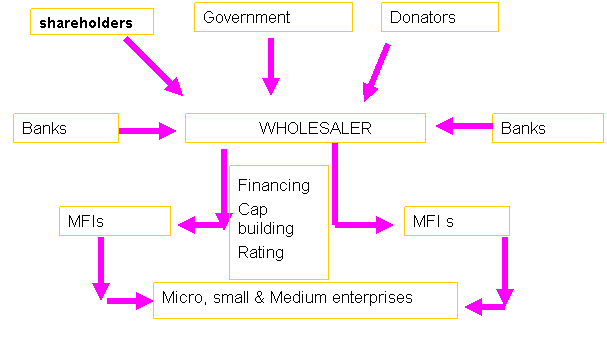
- To obtain agreement from the central bank, Government and Donators- Enter into an agreement with the government for managing the microfinance refinancing fund- To install a rating agency and a training centerFlow of fund |