|
|
|
Infrastructure
and connectivity Current advanced and modern ICT has enabled innumerable global-flows in information, products, people, business opportunity, capital and ideas, which offer great potential for radical improvements both in human development and environments. Since ICT can be a powerful tool for development nowadays, the readiness of ICT infrastructure plays a very critical role in delivering the development program into national goals. Its extensive characteristics allow ICT to be the most useful tools among others development imperatives for enhancing and speeding up a society development among huge disparities in the quality of human livings among countries. Several countries have already put the ICT-infrastructure-program bigger role to contribute a great deal to their development goals. Moreover, ICT infrastructure can be useful at both the micro and national level, such as allowing the effectiveness and reach of development interventions, enhancing good governance, and providing business opportunity for the private sectors. ICT is already being used highly effectively to directly address development goals. In Gambia, for example, it is being used to achieve better health outcomes. In Chile, it is starting to reap significant results in primary school education. In Bangladesh, it has led to the creation of direct employment for thousands of local women and men, while in parts of India new Internet-enabled centers mean better access to different government services for remote communities. In Indonesia, too, ICT is enabling local citizens’ groups to monitor compliance with environmental standards. (Creating a Development Dynamic - Final Report of DOI - July 2001) Government of developing countries should learn from other country’s experience that ICT could provide a dramatic impact on achieving specific social and economic development goals, moreover, play a key role in broader national development strategies. They also have to take appropriate and effective strategies to improve ICT infrastructure into their national development goal. The strategies chosen should be realistic, flexible and sensitive to local conditions, and should be backed by strong public and private institutional support. Above all, there should be a strong commitment to local participation and the fulfillment of local needs, and last but not least, government express political will as clear as possible. A framework proposed by the DOI, suggest that the government should consider several keypoints in formulating their strategies for maximizing their effort and budget to obtain their goals. The framework consists of five related areas; one of them is infrastructure. In infrastructure area, the strategies should be taken into account are as follow:
In many developing countries, the role of government in providing telecommunication service is very deterministic. Government or state-owned company(s) has dominated all telecommunication service from provisioning and maintaining core network infrastructure, as well as providing universal access. However, some privatization and liberalization policies aimed at increasing competition in the sector, has already provided a greater involvement of the private sector in infrastructure provision. Ubiquity and the move toward universal access are becoming more and more feasible due to rapidly declining costs for networking and telecommunication technologies. These declining costs allow developing countries to leapfrog ahead through the use of cutting-edge technologies. In most developing countries, the information network is composed of an all-digital microwave and fiber-optic system with digital exchanges at the main centers. The involvement of the private sector has hastened the adoption of these technologies, particularly in the case of wireless and mobile. The strategy(s) should also focus on the complementarities and synergies between stakeholders and coordination among stakeholders. Infrastructure is rolled out as part of an overall program that includes simultaneous actions in other areas. These stakeholders could involve regulator with adaptive and supportive framework, NGOs, private enterprise and non-profit community as partners, and SMEs and public as service users/customers. The stakeholders should have the same initiatives to expand ICT access and services, and to strengthen demand as a beneficial side effect of addressing development imperatives through a public infrastructure strategy.
Achieving Greater Penetration of ICT Infrastructure Infrastructure is basic requirement for promoting ICT as enabler of development program. When the infrastructure exists, the pace of development will be faster. However, the infrastructure irreadiness is a very general problem in most developing countries, and it is responsible for poverty problem and huge disparities between the rich country and the poor. ICT infrastructure requires telecommunication network, and telecommunications requires electricity. Electricity is basic infrastructure just as roads for transportation. The development of an area is depending on weather electricity is available or not. While the electricity is available, other infrastructures and facilities will follow, such as TVs, telephone, and entertainment. All populated area should have equipped with electricity, no matter how small and poor the population is. Electricity network should have been available to every districts, sub-districts, villages and rural area in NAM member countries. Every village or district must have a community center. It commonly is the most developed place in a village or rural. It could be a local government office, district cooperative, marketplace, religious places (mosque, church or temple), gas stations, or sea or river ports. Establishing community center equipped with telecommunication infrastructure such as telephone, postal service and PCs, is an entry point to open up this village or rural to the world. The villagers could also take benefit of this facility by adopting the knowledge, know-how and information available to their daily living. 3.
Provisioning Telecommunication Access to Rural Area
Government should achieve universal service to cover all villages, rural or sub-districts as early as possible. This universal service should involve all telecom operators, PSTN or mobile, employing any cheap, cost-effective telecommunications solution for certain basic telecom service at affordable and reasonable prices for the rural people. The solution is most likely wireless, both terrestrials and satellite system, to cover bigger area. Rural telecommunication system has widely been studied since 1970-es by ITU, to promote developing countries catching the development gap to industrial countries. 4.
Improving the copper wire quality of local access network The quality of telecom services should be of world standards. The quality of copper wire determines the voice quality and amount of bandwidth of data carried. The good copper wire quality can carry up to 33.6 – 56 kbps of data transmission via dial-up modem. The bad copper wire quality will cause cost-per-kbps of dial-up connection more expensive. 5.
Digitalization of Telecommunication Equipment Switching equipment, transmission equipment (microwave radio system, optical cable network) and local cable network should be “digital ready’, since the Internet and other networking system is in form of digital world. Migrating process from analog system to digital system should be addressed carefully since it will bear huge cost for developing countries. 6.
Providing Digital Transmission / Backbone Network Digital transmission system is built across the country, connecting all cities, provinces, and municipalities throughout the nation. Digital terrestrial radio network is deployed as country’s telecommunication backbones, as well as digital satellite system to cover bigger area in short time. VSAT system is considered to provide rural telecommunication system for spread, low-dense rural area. 7.
Providing High-speed Data Network for Urban and Metro Area
Demands for data telecommunications is getting enormous in the city, demanded by business, academic or young people. Every existing telecommunication infrastructure available should be upgraded to bring more and more bandwidth. Telephone wireline network should adopt xDSL technology to go beyond 2 Mbps data stream. Coaxial cable should introduce cable modem, to provide data capability on top of TV cable network. Optical fiber network should go to every building, serve business with higher speed of the Internet access. Other access system such as wireless technology (LMDS, MMDS, and wireless-LAN) should be deployed to expedite the network deployment. 8.
Adopting Advanced Telecommunication Network Telecommunication technology is evolving during certain period. The digitalization of switching equipment and transmission system had already started by early 1980. Several years later, some improvements took place repetitively. The telecom operator and government should keep their eyes on the technology development, and adopt it whenever they need. Current advanced telecommunication network has gone far compared to the old-fashioned analog telecommunication system. It can now deliver several services via single network, such as ISDN, IN and xDSL. 9.
Establishing an intra-University Network This network is connecting all buildings, faculties/departments, laboratories, libraries, statistic centers, student centers, via a high-speed network such as coaxial cable, Ethernet cable or even optical fiber network. The internal network will provide free-of-charge data communication service, so that it will promote better relationship among resource center in the university. 10.
Establishing an Inter-University Network This network will connect several universities, campuses, libraries, via a private, low-cost network, instead a commercial public-switched network. Since traffic flow among universities is predicted high and continuous, it will be more efficient to build a permanent connection among them rather than using a commercial service. The wireless solution called Broadband Wireless Access or Wireless LAN operating at low frequency band could be ideal. ITU-R has recommended several frequency bands is dedicated as non-commercial band, called ISM (Institution, Science, Medical), such as 1.5 GHz, 2.4 GHz, 5.8 GHz frequency bands. These frequency bands can go travel a long distance, thanks to its lower band, and the implementation cost is getting cheaper since more and more non-commercial institutions around the world using this make the economy of scaling of this technology. 11.
Establishing Distance Learning Facility Government should provide telecommunications facilities available for distance learning to overcome not only the problem of illiteracy, but also education at higher level. The distance learning infrastructure such as video-conferencing, question and answer session, could be facilitated by TV broadcast, satellite system / VSAT, or other wireless solution, having cooperation with open universities or other local educational agencies. Teaching and course contents can also be recorded as multimedia CD-ROMs. This technology can be widely used in the entire spectrum of education: primary, secondary, colleges and higher learning institutes. Moreover, educational institutions from different countries can come together and have programs for getting the best out of their teaching and learning experiences. 12.
Establishing Tele-Medicine Facility This telecommunication system will interconnect rural hospitals and clinics to public hospitals and physician in cities, in order to penetrate to further area in short time as well as cutting down the cost of medical infrastructure and doctors. The network will link to several online sites in hospitals and clinics in national and even regional level, to cutting edge medical information and assistance. 13.
Establishing A Private Network A private network is sometimes required to achieve a specific development goal, such as to penetrate to under-develop communities, or to envoy regional autonomy and tax collecting program, or to monitor the border line area. This private network is via a dedicated network rather than commercial PSTN network due to some reasons from strategic, politic, security or even economical reasons. It should be established to interconnect all stakeholders in the program. For developing a region, it should connect central government institutions (National Planning Body, Statistics Bureau), universities, regional government offices, and NGOs. For autonomy and tax collection program, it should be available on every regional tax offices, state-owned banks, and ministry of finance and tax. The private network should utilize wireless network such as ISM-wireless-LAN network or satellite system using VSAT system in order to get better coverage and quick penetration to certain areas. Other private network called virtual private network (VPN) could be established by utilizing intelligent system of public switched network. This network utilizes commercial wireline and terrestrial network, with deeper accentuation on security issue. 14.
Establishing a Power-Line-Based Telecommunication Network Other alternative to get immediate solution for rural telecommunication system is utilizing power line network as transmission or backbone for telecommunication system. This is an opportunity to penetrate more, since electricity network usually has further penetration in rural areas. The latest technology with such capability is called PLC (Power Line Carrier). A modem is put at transformator to modulate a carrier with operating frequency up to 30 MHz. The low-voltage power-line delivers this carrier to the destination. At the end side, a demodulator converts the carrier into data streams and sends it to telecommunication equipment (switching or router). Every single power line can deliver up to 2 Mbps data streams in TCP/IP format. The high-voltage power-line can deliver higher speed, up to 10 Mbps, and the very-high-voltage power-line can goes beyond that numbers. Other technology for supplying transmission backbone is optical fiber cables installed at the core of the very-high-voltage power-line. One high-voltage power cable can carry one or more optical fibers. 15.
Upgrading National Bandwidth Capacity to the Internet Backbone
The most expensive expenditure in Internet business in developing countries is having connection the Internet backbone. Most of the Internet big hosts and information resides in developed countries. The distance between “north” and “south” region makes the backbone cost is keep high. On the other hand, national demand is keep growing due to Internet becomes more popular everywhere. Strategic steps should be addressed to overcome lack of bandwidth and other potential problem related to multi-lateral involvement. A regional backbone and the Regional Inter Exchange (RIX) should be established to convey Internet traffic among countries in the region. The physical network could be optical fiber network, under-sea cable network (regional or international) or Intelsat Satellite System. Multiple connection to international backbone (mainly to industrial countries) should also be maintained: such as USA-node, ASPAC-node, AUS-node and EUROPE-node. The bandwidth to the Internet backbone should be increased regularly. The incurred cost can be shared among the members of the RIX.
Establishing NAM-CSSTC Program Office in Member Countries The NAM-CSSTC was already established in Jakarta, Indonesia in 1997, as a center or main hub for promoting ICT role in the developing countries. In order to disseminate the study, plan and recommendation already made, as well as bringing a better involvement of the NAM members in promoting ICT for their development, a program or liaison office should be established in every country. The Program Office is to address all networking and connectivity issues, monitoring nation capacity and capability, web preparation and content development, as well as promoting ICT and the Internet awareness among high-level officers and other national stakeholders. Several national pilot projects on selected pilot locations could be undergone under monitoring of this program office. Every country should also establish a national gateway or focal point, which will bring several technical tasks as follow:
Both program office and national gateway tasks could be carried out by the same institution in order to get better coordination and efficiency in term of operational cost.
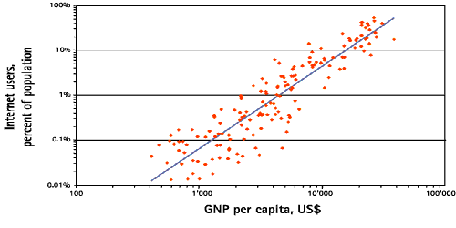
Connectivity will provide more people to interact each other over the distance. Telecommunication and connectivity has played very dominant roles in the worldwide nowadays. Promoting connectivity means providing more computers connect to others via networking technology or system, especially via the Internet. The strategies consist of providing more affordable computers to the people and providing more Internet access available to the computer users, including bandwidth, IP address and domain name. Last but not least, is developing websites, contents and other web applications, make the national information or resource being available to other people in the world. Computer has experienced a paradigm shift from the stand-alone mainframe computers to PCs in the 1990s and, now, with the explosive growth of the Internet, multimedia, and the emergent network-centered computer, the role of PCs becomes more and more dominant. Information and Communications Technology (ICT) as a whole has been making dramatic breakthroughs in the last thirty years. Computer have seen, every 24 months a doubling of the number-crunching capacity and a simultaneous reduction in prices by 50 %, according to the Moore’s Law, one of the founders of Intel, the dominant processor manufacturer of silicon chip in the world. However, the digital divide can easily be seen by comparing penetration of PCs and host computers between developed and developing countries. UNDP reports that 96 percent of Internet host computers reside in the highest-income nations with only 16 percent of the world’s population. There are more Internet hosts in Finland than the whole of Latin America and the Caribbean, more in New York City than on the entire continent of Africa. (UNDP Agenda, October 2000). There is a linear correlation between GNP and amount of income versus Internet and PC penetration as depicted in Figure 1. The more income of a population, the more penetration of Internet users and PC usage happens. Promoting ICT development means promoting PC penetration among people living in developing countries. PC density over population is clearly low, therefore shared-access usage such as in Internet kiosks or telecommunication center could reduce digital divide in a short time. However, the strategies to add up number of PCs from other resources rather than commercial should be addressed. These strategies requires multi approaching from several stake holders :
Figure
1
. Internet Penetration vs GNP per capita (US$) (from International
Telecommunication Union, 2000) Promoting Internet PenetrationInternet is one large network connecting many smaller networks, based on packet switching. The protocol used is TCP/IP, requiring hardware such as router and server. The Internet is made up of components or applications that allow communication takes place rather than as protocol. Those components are : world wide web, e-mail, file transfer, telnet, etc. One
important aspect in the Internet is IP
address and its associated called domain
name. Every country should have plan to regulate how IP address and
domain name is structured and how its development in the future. One
domain name can be associated with one host, so that the progress of the
Internet penetration in one country can be monitored by number of domain
names already registered. The government should target domain name
penetration regularly as well as encourage companies or institutions to
connect to the Internet by registering their domain names. Last but not
least, government should establish a National Network Information Center
(NIC) for top-level domain name registration in each country. One important issue in bringing the Internet down-to-earth is the software, both for web developer and web browser. Java language and HTML should be available and treated as shareware in order to help companies or other institutions create their websites. In the website, they can provide or share resources or information they have to others. The web browser should also available with reasonable price, allowing as many people as possible surf and collect information from the Internet. Other free software or shareware, such as Linux for operating system, should be considered to eliminate software-dependency to certain product. Other important application is electronic mail or email, which allows users to send or receive information in plain text or file attachments, resulting in decreasing the amount of time and bandwidth required for acquiring certain information rather than browsing. This application is suitable for rural location where bandwidth capacity is limited and telephone charge is expensive due to long distance tariff. Developing Content and Web Applications The Web (or more properly, the World Wide Web) was developed at CERN in Switzerland as a new form of communicating text and graphics across the Internet making use of the hypertext markup language (HTML) as a way to describe the attributes of the text and the placement of graphics, sounds, or even movie clips. Since it was first introduced, the number of users has blossomed and the number of sites containing information and searchable archives has been growing at an unprecedented rate. The Web requires a client program (such as Netscape, Internet Explorer, or Lynx) and a server (http) to send information to the client. The client program allows the local user to run an application program to connect to the server, provide a graphical interface for the Web and allow the user to view pictures. Client programs are available in any operating system from UNIX, Windows, to Macintosh. Servers contain files full of information about courses, research interests, map, etc. All of this information is formatted in a language called HTML (hypertext markup language). HTML allows the user to insert formatting directives into the text, with a specific style and format, and convert it into HTML documents. In order to popularize the Internet among the people and to open up their countries to the world, NAM member countries should encourage their people, especially business sectors, universities and R&D bodies, government institutions and SMEs, to providing demand-driven information they are competence in the web. The information should be relevant to the needs and conditions experienced by local people. The information should be in HTML format and should follow rules such as compatibility, language and etc. Several key factors should be considered by every country in order to have successful web developing program and to make the information available and useful to other people. Relevance and Usability. The contents and information delivered in the websites should be responsive to user needs and local conditions. It should be commonly understood, and should comply with technical specifications that are sensitive to the actual use and working environment of users. Partnerships between community networks and the private sector are key in this area, as are consultation mechanisms that facilitate bottom-up approaches and inclusiveness. Language Compatibility. In many developing countries, problems also arise because standard fonts for local languages are unavailable. For such countries, translation into international language and international characters (Latin characters) is an important step, otherwise only very few people can take benefits from the contents. External partners (public, private and citizens in diaspora) can play a key role in this area. For other Latin-character countries, dual-language presentation (international language and native language) will be useful for most people in the rest of the world. Affordability. Unaffordable access is probably the single most important reason for low use of ICT in developing countries. National ICT strategies can facilitate mechanisms for subsidized use and can support reform measures that would lead to the reduction of costs and access charges. Development Applications. In addition, there is a need to build applications that are focused on achieving development goals. These range from those that enhance e-government and e-governance processes, to those that apply ICT to specific development goals, including health, education, empowerment, environmental sustainability and support of employment and enterprise creation. Academic Assistance Program, is proposed to target to help institutions to create websites with low cost. Government institutions, education institutions, NGO, Cooperatives and SMEs can take part of this program by submitting their competence and planned contents. The academic IT experts than will create websites that meet with people’s needs.
|