|
|
|
Self Assessment for E-readiness Rather than starting from scratch, an analytical framework for calculating a country’s IT capability developed by Peter Wolcott (University of Nebraska), Seymour Goodman (University of Arizona) and Grey Burkhart will be adopted for the self-assessment tools as a model for evaluating a country’s e-readiness. This studies however does not provide questionnaire for assessment, rather they rely on qualitative judgment for scoring. What we are developing here is list of question combining qualitative and quantitative data to aid assessment.
Basically, the objective of assessment is to determine level of e-readiness which later could assist policy maker and other concerned parties to improve it. We simply divide the level into the following: Basic
country Basic infrastructure for ICT is available. However usage of ICT are still minimal and need more initiatives to spur them. Developing
country Usage of ICT has been widely adopted. The priority is defining supporting regulation and law to stimulate further growth of ICT. Also more optimization of ICT resources and infrastructure are required. Advanced
country People have been adopting ICT as part of their daily life. They are also demanding more features and finding creative ways to explore ICT. Countries at this level should become role model and lend assistance to countries at the previous two levels.
Many factors are contributing to country level of e-readiness. These were also made complex by inter dependencies between each factors. Economic indicators and welfare is still major driving factors behind e-readiness. However with the free flow of information and global trade, other factors such as cultural and human resources play more crucial role. As countries become more advance in e-readiness, some factors positively feedback and influence shifting of importance of other factors like regulation and government intervention.
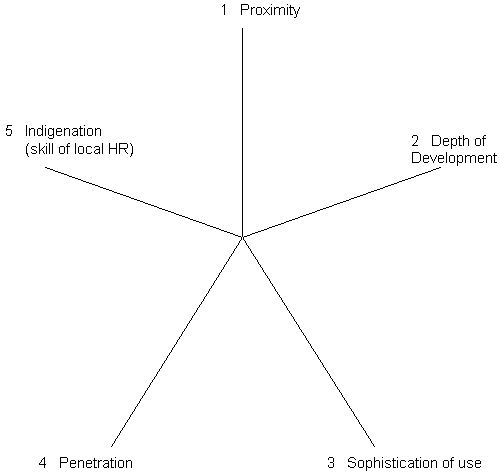
Considering various factors above and complex relationship between them, we group each of them in categories. Within each category, several parameters will determine score of particular category. Simple averaging of scores determines the total score for each category. Later, categories become axis in radar chart and score is plotted along its axis with 0 (zero) in the center. Pattern on radar chart of all categories will be used to approximate e-readiness of the country. This analytical formula evaluate the e-readiness condition from 5 categories:
Each of these categories is described below: Proximity to technological frontier Level 0: (Non-existent) The technology does not exist in this country and therefore is immeasurably far from the technological frontier. Level
1: (Obsolete) Technology is several generations behind the worldwide state of the art. While it may be functional, it is only marginally so, posing significant maintenance and operational challenges due to the length of time in service and/or changes in the environment of its use to which the technology cannot be adapted. The technology may be viewed as a constraint rather than as an enabler. Level 2: (Non-competitive) The technology represents a previous generation, but may still have useful applications. This level also includes current generation, or near-current, technology that is not internationally competitive, possibly for reasons related to weakness in technological features, quality, cost or level of services. Frequently, the output of protected domestic industries fall into this category. Examples: IBM PC XT, AT, 286, 386; Indian Param High Performance Computing System, Soviet mainframes. Level 3: (Competitive) The technology used is internationally competitive technology, although not defining the state of the art. Such technology is usually mature, and may have been superseded by more recent models. It is sometimes referred to as “the business state of the art”, reflecting the common business practice of adopting technology not when it is first introduced, but after the technology has stabilized and the performance/ price ratios have improved. Level 4: (Leading) The technology defines the state-of-art. It is usually the product of extensive R&D efforts. Those adopting the technology are considered “early adopters” and are willing to endure a significant amount of inconvenience due to the relative immaturity of the technology. Although the technology might require hand holding from vendor, it is more than “research in progress”. Level 0: (Consuming) No development takes place in the country. Technology, when present, is imported as a finished product. Level 1: (Assembling) Development consists of simple assembly. Little or no process or product innovation takes place. At this level, there is no unsophisticated development. Level 2: (Adapting) Moderately sophisticated development is done with significant amount of external assistance, perhaps via licensing agreements. Work may be done to adapt the technology to local conditions. Level 3: (Advancing) Domestic firms are actively involved in advancing the relative state of the art in some, although not necessarily all, stages of development. There are efforts to improve the product or processes related to its development, even if those products or processes are not considered worldwide state of the art. Level 4: (Comprehensive) Basic research, applied research, design and development, process innovation, and also final production are carried out within the country. Supporting technologies and service also often originate within country. Some stages may be outsourced, but for economic, rather than technical reasons. Level 0: (No at all) The technology is not used. Level 1: (Assisted) User community struggles to employ technology in conventional, mainstream applications and requires significant foreign assistance our outside pressure to do so. Users may desire the technology, but may resist the changes to established practices that are needed to take advantage of the technology. Users to not push the boundaries of the technology’s capabilities, nor does the technology significantly change the way they go about their activities. Without outside pressure to use it, the technology will fall into disuse. Level 2: (Conventional) Usage is limited to conventional, mainstream applications. The user community may change established practices somewhat in response to the technology or to accommodate the technology, but only little innovation is done. Few established processes are changed dramatically. Using technology to automate, but not fundamentally alter. Usage does not push the boundaries of the technology’s capabilities. Level 3: (Innovating) The user community’s use of the technology may result in new applications or significant changes in existing process and practices although these innovations may no necessarily stretch the boundaries of the technology’s capabilities. Users may also take advantages of some of the more advanced features of a technology and taking full advantage of its capabilities. Level 4: (Transforming) The user community is discriminating and highly demanding. The user community is regularly applying or seeking to apply the technology in innovative ways that push the capabilities of the technology. Existing processes are regularly transformed to prepare for the new technologies. The user community may play a significant role in driving the local state of the art and may have a mutually beneficial and synergistic relationship with the developers. Level 0: (Non existent) Technology does not exist in a viable form. Level 1: (Entrant) Experimental or isolated examples of the technology exist. This may reflect the first instances of the technology to appear within the country or a greatly reduced level of activity. The supporting infrastructure of goods, services, and complementary industries is very underdeveloped. Level 2: (Established) The technology is used by a small number of users, but is not considered unique. Experience with the technology is accumulating. The infrastructure of goods and services needed to support broad penetration of the technology. Level 3: (Common) The technology has been adopted by a significant fraction of potential users within the country. The infrastructure of supporting and related goods and services has become well established, although is not necessarily extensive. Level 4: (Pervasive) The technology is pervasive. Its absence is more noteworthy than its presence. The number of first time adopters of the technology is quite small. The supporting infrastructure and related good and services are well extensive.
Level 0: (Observing) There is no involvement by nationals. Operation, maintenance, use and adaptation of technology performed by foreign personnel. The only personnel involved with the technology are foreign employees of the corporation. Level 1: (Operating) National personnel may use and operate the technology, but foreigners perform installation, maintenance, support, development and adaptation. Level 2: (Supporting) Indigenous personnel are significantly involved in the technology’s operation and use, and also perform many of the routine tasks, including routine maintenance. Foreign personnel largely install technology and are involved in non-routine servicing and up grading technology. Level 3: (Managing) Indigenous personnel largely perform installation, use, operation, maintenance, management and adaptation of the technology. However, foreign experts continue to provide key knowledge and services in selected areas. Level 4: (Mastering) Completely indigenous activity. Indigenous personnel are involved in, and have mastered in all aspects of installation, operation, development, management, use, adaptation and even innovation of the technology. The radar chart with axis representing each categories is described in figure 1 below.
Figure 1 . Radar chart with axis representing each category in assessment
Government has many vital roles in society including assuring stability, peace, equity and justice. Government’s most important task in increasing E-readiness is to create an environment that encourages private sector action, while protecting customers. E- leadership addresses the scope and nature of government and industry efforts to promote the networked world within a country and to promote the country as a regional or global center in the networked world. Key elements include:
The existing business environment and government’s role in the national digital economy shapes the quality of e-leadership needed in any particular country.
In every country, a relationship of trust, accountability, and predictability between public and private sectors is essential. For nations with a laissez-faire, market oriented economy where the government does not itself dominate the economy or the provision of communication services, staying out of the way of market forces, except to protect consumers, is the first priority. The second essential activity in these cases is for government to transform its own operations using the power of ICTs to decrease costs and improve service.
For nation where government remains predominant, the first task is to create an environment in which the ICT industry can thrive and take its place in the world marketplace-thus attracting capital and expertise. The second task the same as for countries in the first group. Without the injection of ICT into the core of government operations, policy makers will neither understand what the technology can do nor appreciate the kind of light-handed regulation that the volatility of technology demands.
E-leadership will continue to grow in importance as competition among countries intensifies, as will the need for environments and official that welcome creative public-private partnerships. The assessment will focus on three aspects described below.
Although it is tempting to produce a single index number to determine e-readiness level as a result of this assessment, we are trying to avoid it. Therefore what we propose is that we collect result from various countries which participate in this survey. Next, based on the result, we can compose and statistically grouping various countries. These grouping and their radar chart pattern will be presented to expert group or task force of NAM CSSTC. They will collectively agreed on pattern which represent each level of e-readiness.
Further as we try out the assessment for Indonesia, we find that ICT can actually be represented by two broad sectors, namely telecomm infrastructure and information technology. Therefore we propose that we will look at these two sector separately rather than combining them.
Special section of the assessment also allocated for e-leadership. This was done based on the discussion of second expert group meeting which recognized the importance of government role in leading the e-readiness of developing country whereby the government is still predominant over business environment.
The last chapter of this document provides example of assessment for Indonesia. As described above the results are basically three parts. The first one is telecomm infrastructure and close related in second part is information technology. The last one is e-leadership which would support e-readiness in the previous two sectors.
|